2 ~ Barthe M., Rancilhac L., Arteaga M. C., Feijó A., TilakM.-K., Justy F., Loughry W. J., McDonough . M., de Thoisy B., Catzeflis F., Billet G., Hautier L., Nabholz B., & Delsuc F. (2025). Exon capture museomics deciphers the continent-wide nine-banded armadillo species complex and identifies a new species endemic to the Guiana Shield. Systematic Biology. Syae027
1 ~ Barthe M., Doutrelant C., Covas R., Melo M., Illera J. C., Tilak M.-K., Colombier C., Leroy T., Loiseau C., & Nabholz B. (2022). Evolution of immune genes in Island birds: Reduction in population sizes can explain Island syndrome. Peer Community Journal , 2, e67
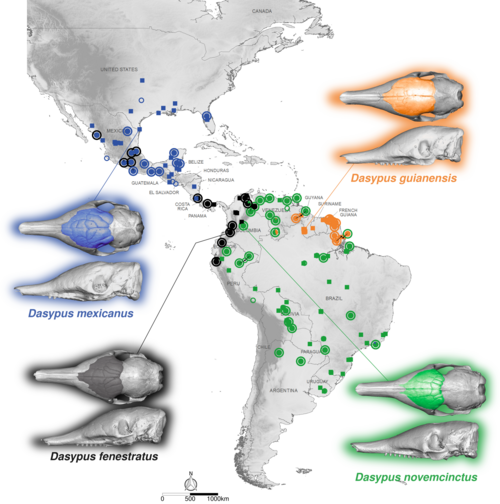
The nine-banded armadillo (Dasypus novemcinctus) is the most widespread xenarthran species across the Americas. Recent studies have suggested it is composed of 4 morphologically and genetically distinct lineages of uncertain taxonomic status. To address this issue, we used a museomic approach to sequence 80 complete mitogenomes and capture 997 nuclear loci for 71 Dasypus individuals sampled across the entire distribution. We carefully cleaned up potential genotyping errors and cross-contaminations that could blur species boundaries by mimicking gene flow. Our results unambiguously support 4 distinct lineages within the D. novemcinctus complex. We found cases of mito-nuclear phylogenetic discordance but only limited contemporary gene flow confined to the margins of the lineage distributions. All available evidence including the restricted gene flow, phylogenetic reconstructions based on both mitogenomes and nuclear loci, and phylogenetic delimitation methods consistently supported the 4 lineages within D. novemcinctus as 4 distinct species. Comparable genetic differentiation values to other recognized Dasypus species further reinforced their status as valid species. Considering congruent morphological results from previous studies, we provide an integrative taxonomic view to recognize 4 species within the D. novemcinctus complex: D. novemcinctus , D. fenestratus , D. mexicanus , and D. guianensis sp. nov., a new species endemic of the Guiana Shield that we describe here. The 2 available individuals of D. mazzai and D. sabanicola were consistently nested within D. novemcinctus lineage and their status remains to be assessed. The present work offers a case study illustrating the power of museomics to reveal cryptic species diversity within a widely distributed and emblematic species of mammals.
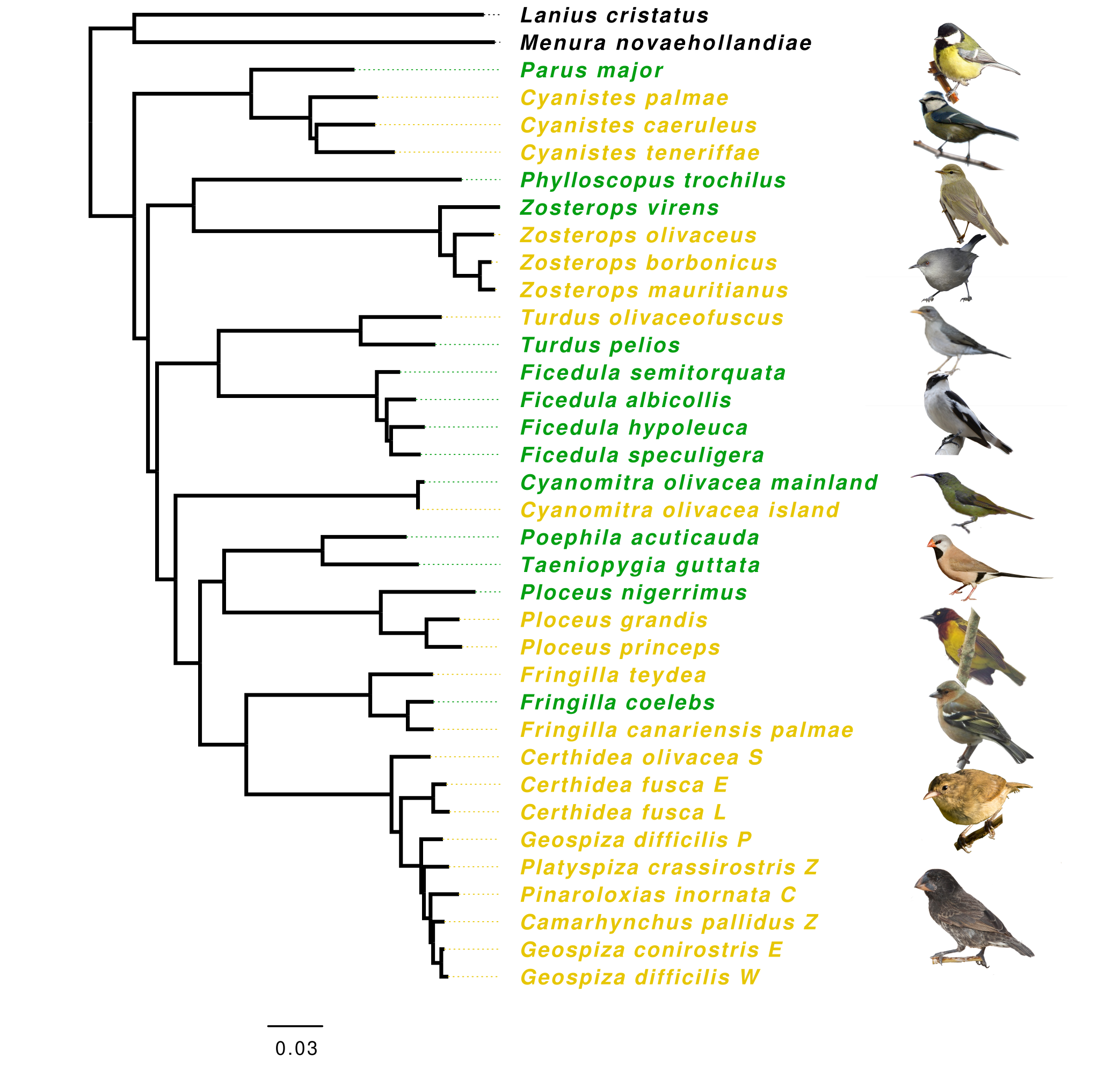
Shared ecological conditions encountered by species that colonize islands often lead to the evolution of convergent phenotypes, commonly referred to as “island syndrome”. Reduced immune functions have been previously proposed to be part of this syndrome, as a consequence of the reduced diversity of pathogens on island ecosystems. According to this hypothesis, immune genes are expected to exhibit genomic signatures of relaxed selection pressure in island species. In this study, we used comparative genomic methods to study immune genes in island species (N = 20) and their mainland relatives (N = 14). We gathered public data as well as generated new data on innate (TLR: Toll-Like Receptors, BD: Beta Defensins) and acquired immune genes (MHC: Major Histocompatibility Complex classes I and II), but also on hundreds of genes with various immune functions. As a control, we used a set of 97 genes, not known to be involved in immune functions based on the literature, to account for the increased drift effects of the lower effective population sizes in island species. We used synonymous and non-synonymous variants to estimate the selection pressure acting on immune genes. We found that BDs and TLRs have higher ratios of non-synonymous over synonymous polymorphisms (Pn/Ps) than randomly selected control genes, suggesting that they evolve under a different selection regime. However, simulations show that this is unlikely to be explained by ongoing positive selection or balancing selection. For the MHC genes, which evolve under balancing selection, we used simulations to estimate the impact of population size variation. We found a significant effect of drift on immune genes of island species leading to a reduction in genetic diversity and efficacy of selection. However, the intensity of relaxed selection was not significantly different from control genes, except for MHC class II genes. These genes exhibit a significantly higher level of non-synonymous loss of polymorphism than expected assuming only drift and evolution under frequency dependent selection, possibly due to a reduction of extracellular parasite communities on islands. Overall, our results showed that demographic effects lead to a decrease in the immune functions of island species, but the relaxed selection that is expected to be caused by a reduced parasite pressure may only occur in some categories of immune genes.